



Maximize flow, minimize pump damage.
GasStorm
Maximize flow, minimize pump damage.
Every stroke that fills with gas is production you don’t lift. PetroQuip’s GasStorm separates free gas from produced fluids below your sucker rod pump (SRP), with no cup packer or external seal against the casing. Gas exits the top of the tool through a sand screen while produced fluids stay inside the tubing string, so your pump barrel fills with liquid, not gas.
No moving parts and minimal pressure drop. Designed for SRP wells in 5-1/2" and 7" casing with gas interference.
-
Increases pump fillage by separating free gas before it reaches the SRP
No cup packer or external sealing devices
Produced fluids stay inside the tubing string; gas exits the top through a sand screen
Gas and fluid take separate paths, so fluid never enters where gas is trying to escape
Sand from below travels up the center dip tube, away from the separator internals
Runs with or without SandStorm-S
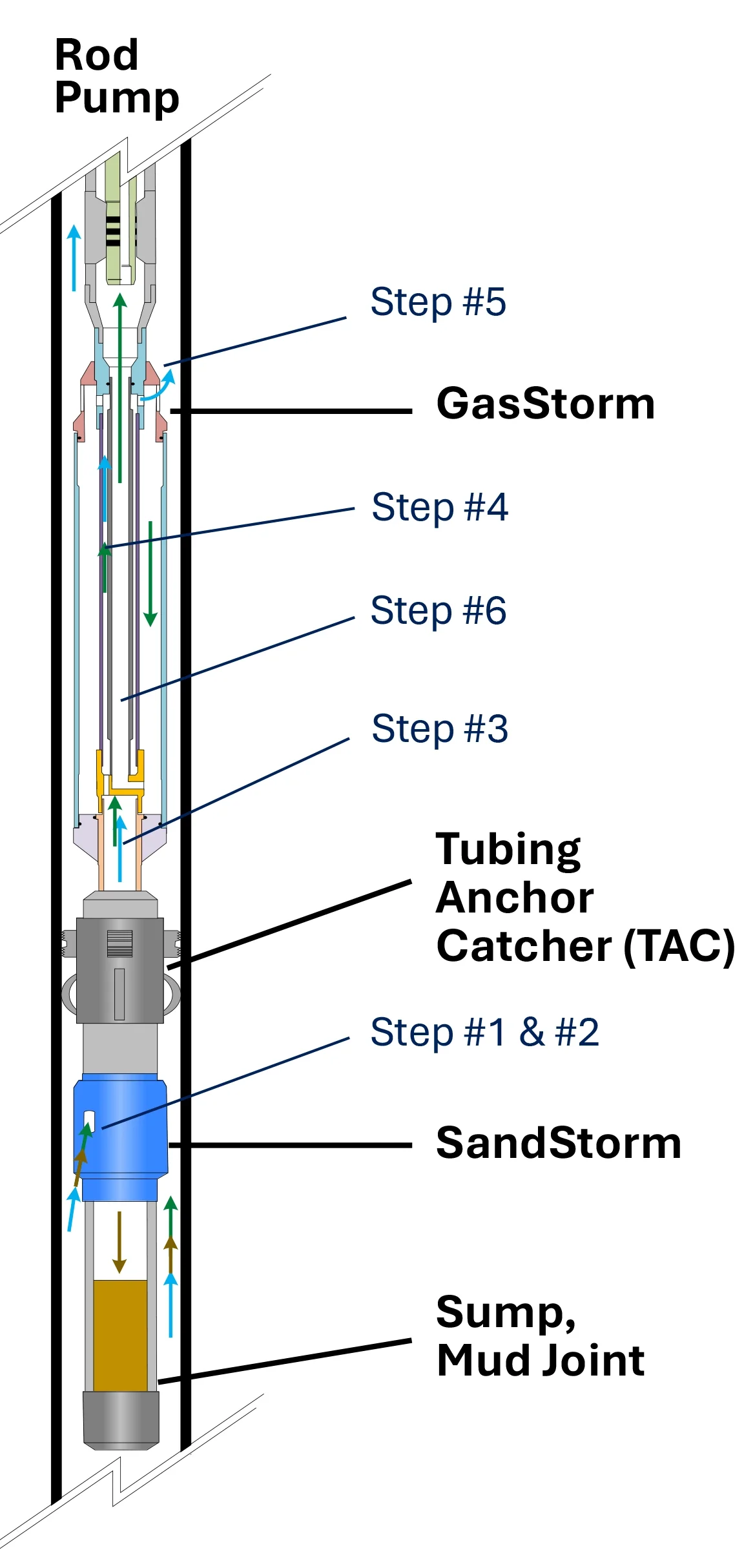
When paired with SandStorm-S and a tubing anchor catcher (TAC), flow moves through SandStorm-S (sand out), through the center of the TAC (no slimline TAC needed), then into GasStorm (gas out), so only wellbore fluid reaches your SRP.
No moving parts, minimal pressure drop and an 80,000 lbs tensile rating
A portion of proceeds from every unit sold goes to The PetroQuip Foundation
-
PROBLEM:
Free gas that reaches a sucker rod pump takes up barrel space meant for liquid. Pump fillage drops, gas interference sets in, and every partial stroke costs you production and shortens pump life.
SOLUTION:
PetroQuip’s GasStorm separates free gas below the pump through its internal flow path, with no cup packer. Fluid and gas speed up through the tool’s inner annulus. As the flow turns into the outer annulus, the gas breaks out and exits the top through a sand screen. The liquid re-enters at the bottom of GasStorm and flows up to your pump.
Run it on its own, or pair it with SandStorm-S to remove sand and gas in one string. SandStorm-S drops the sand into the sump before the flow reaches GasStorm.
-
Thread up: 2-7/8" Box
Thread down: 2-7/8" Pin
Separator OD: 4.500" and 5.500"
Tensile: 80,000 lbs
Temperature rating: 350°F
-
Combine GasStorm with PetroQuip's SRP solutions for comprehensive sucker rod pump protection.
SandStorm-S - SRP sand separation
SandMaze SRP - SRP fallback prevention


FROM THE FIELD
“Our pump efficiencies went from 65-75% to 90%+ on both wells, getting us close to another 50-75 BFPD per well.”
— SRP operator, January 2026
VIDEO: Watch our animation to see how SandMaze SRP, SandStorm-S, and GasStorm work together to protect SRPs.
Minimal pressure drop
Every psi lost across a gas separator is a psi lost at your pump intake. Lower intake pressure lets more gas break out of solution and leaves less pressure to fill the barrel, which works against the separation you installed the tool to get.
GasStorm separates free gas while keeping pressure drop minimal, even at high flow rates. The chart shows pressure drop through the tool across its flow range.
Send us your flow rate and our team will give you the expected pressure drop for your well.

How it works:
Run GasStorm with SandStorm-S and a tubing anchor catcher (TAC), GasStorm completes a sand and gas protection string below your rod pump. SandStorm-S removes the sand first, the flow passes through the TAC, and GasStorm separates the free gas, so your pump receives de-sanded, de-gassed fluid. Follow the numbered steps on the diagram to trace the flow from the sump to the pump.
Step 1: Flow enters SandStorm-S.
Step 2: SandStorm-S separates out the sand and drops it into the sump (mud joint).
Step 3: De-sanded fluid and gas pass through the TAC, not around it, so no slimline TAC is needed.
Step 4: Fluid and gas enter GasStorm and speed up through the tool’s inner annulus.
Step 5: As the flow turns into the outer annulus, gas breaks out. The liquid re-enters at the bottom of GasStorm.
Step 6: De-gassed, de-sanded fluid flows up to the rod pump.
Questions? Connect with our team for more information.
GasStorm vs competing designs
GasStorm:
No cup packer
Gas exits the top through a sand screen; produced fluids stay in the tubing
Sand from below travels up the center dip tube
Runs with or without SandStorm-S
Designed for 5-1/2" and 7" casing


Competing designs:
Sand, fluid and gas travel along the outside of the tool, then the sand passes inside, eroding the internals
Fluid enters where the gas is trying to escape
No option to run without a desander
Stop losing production to gas interference.
Tell us about your well: casing size, flow rate, and where gas interference is costing you production. Our engineering team will help you size GasStorm for your conditions, on its own or paired with SandStorm-S, and build the right protection string for your rod pump. Contact our team today to help protect your SRP equipment.
Email: sales@petroquip.com
Phone: 936-931-0100